How to choose the professional cryotherapy that best suits your needs.
An in-depth guide to the different types of cryotherapy, with a critical and practical analysis.
Latest Article
The term ‘cryotherapy’ is often used generically to describe any application of cold for therapeutic or sporting purposes. In reality, however, the available technologies differ substantially in terms of physical principle, cooling depth, parameter stability and the possibility of integration into structured clinical protocols. It is not simply a matter of “how cold it is”, but of how well the cooling is controlled over time.
What does cooling really mean? There is a fundamental difference between:
- skin temperature
- deep tissue temperature
- subjective perception of cold.
Many systems produce a rapid reduction in surface temperature, generating an intense sensation. However, in orthopaedics and rehabilitation, the clinically relevant parameter is the stability and management of the thermal gradient in deeper tissues.
Reduction in intramuscular temperature:
- is slower than at the surface
- depends on maintaining the gradient
A rapid peak does not necessarily equate to a stable therapeutic effect.
This is where the concept of the thermal curve over time comes into play.
Temperature trend: peak vs. stabilisation
Each technology produces a different thermal profile. For example:
- Ice: rapid but variable and uncontrolled cooling
- Cold Water Immersion (CWI): gradual descent depending on volume and body surface area
- Whole-body cryotherapy (WBC): very rapid surface peak and short exposure.
- Controlled flow systems produce a programmed descent and stable maintenance.
Stable maintenance of the parameter allows for:
- Repeatability of treatment
- standardisation between patients
- Integration into post-operative protocols
- Clinical documentability
For this reason, it is essential to select technology based on clinical objectives, settings and patient profiles.
1) Traditional cryotherapy: ice/cold packs.
Mechanism: superficial cooling by direct conduction, local vasoconstriction and reduced cellular metabolism, resulting in pain relief.
Typical parameters: intermittent applications (10–20–30 minutes), with an uncontrolled temperature depending on the ice.
Evidence and use: widely used as first aid (RICE method), providing short-term relief for acute trauma. However, the lack of temperature control makes it less suitable for repeatable clinical protocols. (Universally used, but with practical limitations).
Advantages/disadvantages: inexpensive and portable, but not easily repeated in a standard way, with a risk of cold damage if applied incorrectly.
Practical applications: first aid and temporary home therapy.
Summary: excellent for emergencies and low-cost use, but avoid for clinical protocols that require measurability and repeatability.
2) Cold water immersion (CWI):
Mechanism: Convection and contact with the water body. This provides more uniform and deeper cooling than bags and induces vasoconstriction. Upon exiting the water, recirculation occurs due to warming and subsequent vasodilation.
Typical parameters: 8–15 °C for a duration of 5–15 minutes for partial immersion (legs), or 10–15 minutes for total immersion, depending on the protocol.
Evidence: Recent systematic reviews and meta-analyses provide solid evidence that CWI is effective in reducing DOMS and improving subjective recovery after intense exercise, although the effects on biochemical indicators are variable. (See the systematic review and meta-analysis on CWI and recovery.)
PMC: https://pmc.ncbi.nlm.nih.gov/articles/PMC9896520/.
Advantages: highly effective for athletic recovery and adjustable.
Disadvantages: complex logistics (tub), demanding maintenance and unsuitable for patients with severe cold intolerance or uncontrolled cardiovascular disease.
Practical applications: sports centres, professional teams and post-competition protocols.
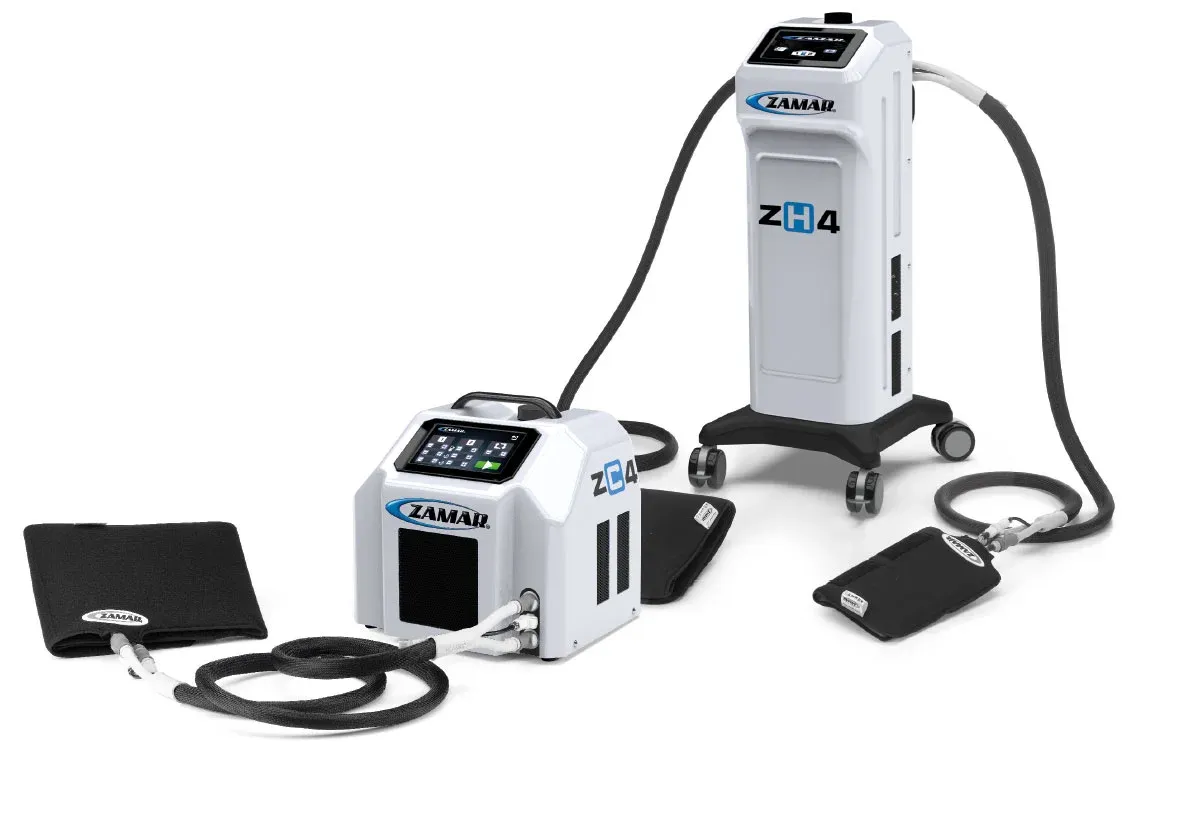
3) Cryocompression (cold and sequential compression): controlled flow systems, e.g. ZAMAR.
Mechanism: a combination of cooling by a circulating fluid (or other controlled source) in contact with the anatomical region, and sequential or intermittent pneumatic compression.
The synergy is that cold reduces inflammation and pain, while compression improves lymphatic drainage and venous return, thereby amplifying the reduction of oedema.
Typical parameters include adjustable temperature (e.g. 0–40 °C for professional products) and programmable sequential pressure (e.g. 20–100+ mmHg, depending on the protocol and model). Professional units allow for cycles and simultaneous treatment of two areas.
Recent studies show that continuous liquid, as well as those combined with compression, can maintain therapeutic temperatures more reliably. In some post-operative applications, such as total knee arthroplasty (TKA), they can help to reduce oedema, pain and analgesic consumption. Clinical trials have compared the ability of different devices to lower skin temperature in the target area.
PMC: https://pmc.ncbi.nlm.nih.gov/articles/PMC9692982/.
Advantages: excellent temperature control and repeatability; ability to integrate protocols.
Disadvantages: higher cost; need for training and maintenance.
It is an excellent choice for clinics and professional physiotherapy.
Practical applications: orthopaedic post-surgery, targeted sports recovery, controlled oedema and lymphoedema management, and home physiotherapy with special portable devices.
4) Dry air cryotherapy/cold air flow
Mechanism: Cold, dry air is delivered locally via handpieces and does not use liquids.
Typical parameters: variable surface temperature; short duration for sensitive areas.
Evidence and use: it is often used in dermatology to reduce post-procedure redness and for non-ablative superficial cryotherapy. The absence of moisture makes it practical and useful in clinical settings.
Advantages/disadvantages: convenient and clean; less cooling depth than contact with liquids; variable patient comfort.
5) Whole-body cryotherapy (WBC)
Mechanism: rapid and total exposure of the body to extremely cold air in chambers or cabins at temperatures typically ranging from −110°C to −190°C for 1–4 minutes, resulting in very rapid surface cooling and neuroendocrine responses.
Evidence: The literature is mixed: some studies report subjective improvements in pain, well-being and recovery, while meta-analyses and reviews highlight methodological discrepancies and the need for more rigorous studies on objective clinical outcomes. Comparisons with CWI show different short-term effects, but there is no necessarily strong and consistent clinical superiority.
ScienceDirect: https://www.sciencedirect.com/science/article/pii/S0965229921001242
Pros and cons: a quick and popular experience in wellness centres and among professional sports teams, but high costs and the effectiveness of safety requirements and regulatory issues must be evaluated on a case-by-case basis. It is not always recommended for patients with cardiovascular disease or other contraindications without medical screening.
6) Peltier/thermoelectric devices and portable devices
Mechanism: The thermoelectric (Peltier) effect is used to cool small areas without moving parts or gas.
Evidence: useful for lighting and household applications, but with limited efficiency compared to compressor or immersion systems. Studies and technical reviews describe their applications and limitations.
ScienceDirect: https://www.sciencedirect.com/science/article/pii/S1555256X2200114X
PRACTICAL COMPARISON: HOW TO CHOOSE THE RIGHT TECHNOLOGY
Use the following parameters to help you decide:
Therapeutic objective:
- Post-op local therapy: cryocompression/CCF
- General athletic recovery: CWI, WBC or cryocompression/CCF (depending on the context)
- Skin lesion removal: cryosurgery
Need for control and repeatability
If documentation and repeatable protocols are required, choose systems with digital control (e.g. cryocompression or CCF).
Logistics and budget: For high clinical throughput, choose wheeled/centralised units. For flexibility, choose portable models.
Safety/patient: screen for cardiovascular disease, cryoglobulinemia, neuropathies and pregnancy.
Scalability: centres with many patients should favour systems that allow for simultaneous treatments or rapid turnover (e.g. units that support two braces).
RISKS, CONTRAINDICATIONS, AND SAFETY MANAGEMENT
Important contraindications include cryoglobulinemia, previous cold burns, severe circulatory failure, certain uncontrolled heart diseases and pregnancy (evaluate on a case-by-case basis). Uncontrolled hypertension is also a contraindication, especially for whole-body cryotherapy (WBC).
Good practices include medical screening before WBC or extended exposures, protection of sensitive areas, recording parameters for repeated medical therapies, scheduled maintenance of devices to avoid contamination and/or malfunctions, and operator training.
Documented adverse events include cold burns/exposure injuries and vasospastic reactions if used inappropriately. In WBC, rare cases of acute complications in unsuitable subjects have been reported.
ScienceDirect: https://www.sciencedirect.com/science/article/pii/S0965229921001242
Summary conclusion
For clinical and post-operative applications, cryocompression and circulating water systems offer the best balance of effectiveness, safety and traceability.
PMC: https://pmc.ncbi.nlm.nih.gov/articles/PMC9692982/.
For sports recovery, CWI is a well-established choice, supported by robust evidence for alleviating delayed-onset muscle soreness (DOMS) and improving subjective recovery.
PMC: https://pmc.ncbi.nlm.nih.gov/articles/PMC9896520/.
WBC remains a popular solution in wellness and high-performance settings, but there is mixed clinical evidence and a need for careful evaluation of the cost/benefit ratio and safety.
ScienceDirect: https://www.sciencedirect.com/science/article/pii/S0965229921001242
APPENDIX: MAIN SOURCES AND REFERENCES (SELECTED LIST)
Xiao F., et al. Effects of cold water immersion after exercise on fatigue and recovery — Systematic review & meta-analysis, 2023. PubMed Central.
PMC: https://pmc.ncbi.nlm.nih.gov/articles/PMC9896520/
Belsey J., et al. A randomised crossover trial of five cryocompression devices — PLOS ONE, 2024. (confronto diretto sulla capacità di abbassare la temperatura cutanea).
PLOS: https://journals.plos.org/plosone/article?id=10.1371%2Fjournal.pone.0296634&utm
Coviello M., et al. Continuous Cold Flow Device Following Total Knee Arthroplasty — PMC article, 2022 (esempi clinici su CCF dopo TKA).
PMC: https://pmc.ncbi.nlm.nih.gov/articles/PMC9692982/
Feng C., et al. A systematic review and meta-analysis on cryostimulation/cryotherapy after exercise — PMC, 2024 (riassunto degli effetti su fatica e dolore).
PMC: https://pmc.ncbi.nlm.nih.gov/articles/PMC11200300/
Doets JJR., et al. Systematic review/meta-analysis on whole-body cryotherapy — (revisione critica, 2021). ScienceDirect: https://www.sciencedirect.com/science/article/pii/S0965229921001242
StatPearls / Prohaska J. Cryotherapy in Dermatology — StatPearls (NCBI Bookshelf), 2023 (criosurgery, uso dell’azoto liquido). NCBI: https://www.ncbi.nlm.nih.gov/books/NBK482319/
DermNetNZ — Guidelines sulli usi dell’azoto liquido in dermatologia. DermNet®: https://dermnetnz.org/topics/liquid-nitrogencryotherapy-guidelines
Derrick CD, et al. The Safety and Efficacy of Cryolipolysis: A Systematic Review — Aesthetic Surgery Journal (2015). PubMed: https://pubmed.ncbi.nlm.nih.gov/26038367/
Shilpa MK, et al. Systematic review of Thermoelectric (Peltier) devices in medicine (review tecnico). ScienceDirect: https://www.sciencedirect.com/org/science/article/pii/S1555256X2200114X
Rapid review: Cryotherapy for total knee arthroplasty (TKA) — health technology/rapid review (es. MUHC libraries). muhclibraries.ca: https://www.muhclibraries.ca/Documents/RR_Final-Report_Cryotherapy-TKA_JAN2018.pdf
Altri lavori recenti e studi clinici su CWI, WBC e dosaggi: articoli 2023–2025 individuati in PubMed/PMC (es. confronto temperatura/ tempo tra WBC e CWI; rassegne narrative sui DOMS).
MDPI: https://www.mdpi.com/2075-1729/15/8/1205?utm